story
How musicians are navigating social media usage for music promotion
By: Allie Payne
November 19, 2025
Story highlights:
* The evolving social media landscape has shifted to reward short-form content on platforms like Instagram, where Instagram reels saw a 35% increase on engagement with music related content, according to an article by Jeremy Pregent for DAC group, a digital media agency. In turn, musicians and artists are using social platforms as a marketing tool.
* In pursuit of going viral, some musicians are sacrificing quality of content in pursuit of a viral moment, sometimes trimming songs to place emphasis on the chorus. This can be seen through popular artist Pink Panthress in an ABC News YouTube video stating that songs don’t need a bridge, a repeat verse or a long outro.
* Some bands are also participating in clip farming, where bands post staged content with efforts to go viral, according to local showgoer Melia Ferbush. These clips can further contribute to the oversaturation of inauthentic voices within the music scene.
SAN DIEGO - In the modern day media landscape where 68% of users discover new music through short-form video content, bands have taken to marketing on trending social platforms. As a result, the music scene is seeing an increase in inauthentic production and promotion, according to a study by MusicWatch, a company that provides marketing research and analysis for the entertainment industry.
“I think that it’s important in drawing a crowd, yes, because now we’re seeing like social media feeds and posts are more of the prominent way that we are advertising things,” Local Concert Photographer Sydney Pista said. “You don’t see a ton of bands advertising themselves on television, or even the radio with smaller, local bands.”
In 2025, social media is seen as the primary promotional tool for artists and musicians hoping to break into the music scene without the backing of traditional gatekeepers, like airing on a radio station or getting signed to a major record label, according to Jason Levine of AMW Group, an organization that provides marketing services for musicians.
Social media’s effects on measuring success and creativity
Check out this YouTube Short about what social platforms are trending for music promotion: Popularity Social Post
Social media is shifting the scope on how booking agents and music professionals measure musician success, looking at marketing strategies and audience engagement, in addition to views and call to action impressions, according to Jam Agency, an organization that provides marketing campaigns and communication strategies to help businesses grow their brands.
According to TikTok’s recap of 2024 where the company shared their impacts on culture, trends, business, music and more, the platform cemented its precedence in the music landscape by revolutionizing how songs are advertised, how up-and-coming artists emerge and how audiences connect with their favorite bands. Seen through record-breaking artists, online small-business communities and lasting social impacts, TikTok has become a catalyst for economic progress and social change.
Bands using social media platforms like TikTok as a tool for marketing and promotion has also influenced the way creatives within the local scene approach their work. In her role as a local concert photographer, working with bands and artists to shape their social media presence, Sydney Pista has noticed the shifting landscape toward utilizing social media and its effects on aspiring musicians.
“I feel like a lot of the stuff I like to shoot for bands is stuff that I’m hoping that they will post on social,” Pista said. “So I’m keeping in mind the aspect ratios that you want for social media, different things that are trending on socials [like] the different filters and types of shots people are liking.”
Although curated photography posts with the proper hashtags and filters are an aspect that can lead to more audience engagement, Pista acknowledges that consistency and discoverability are details she considers to be helpful for lasting success.
“Yes, more engineered content can fit into algorithms better and you’ll get on more like trending pages,” Pista said. “But if you’re posting a lot with key words just like posting to your fans and appealing to your local fanbase, your odds of having a video blow up are going to be much higher.”
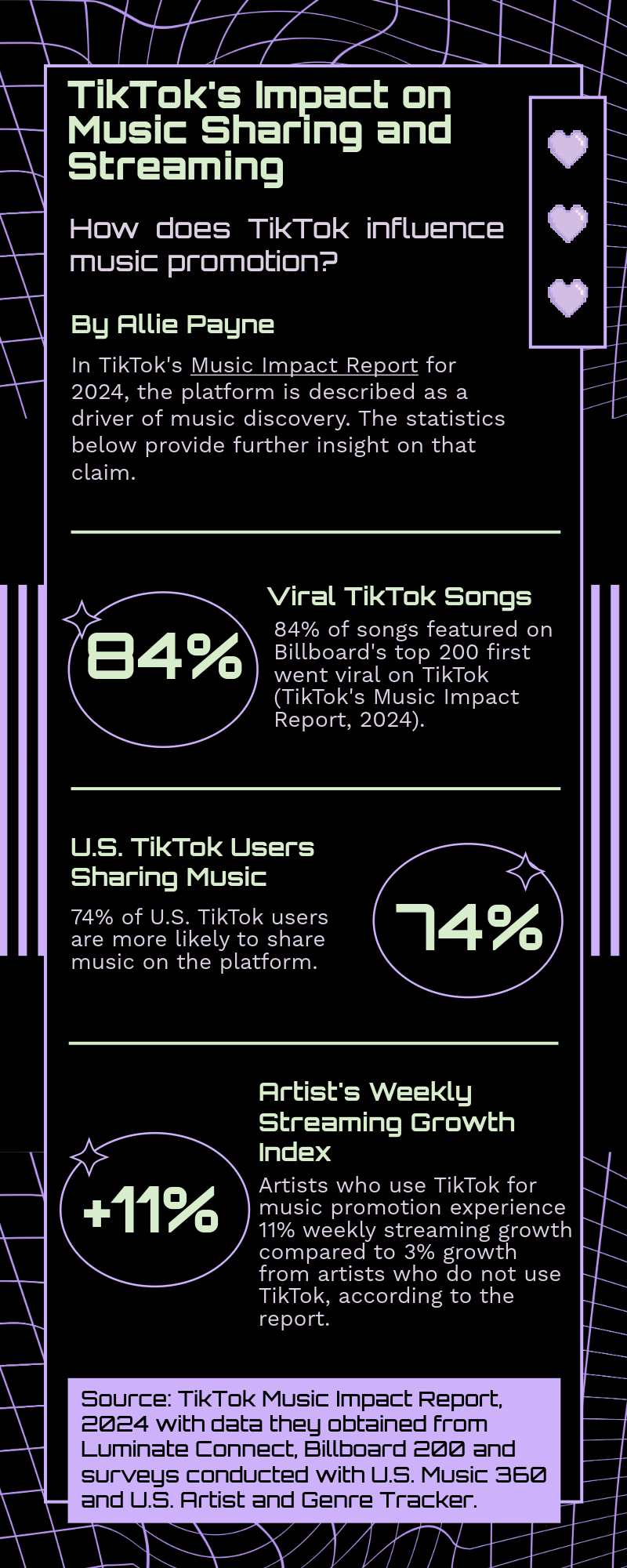
In 2024, TikTok published their Music Impact Report, which features data collected from Luminate Connect and Billboard Global 200 based on surveys of audience insights from U.S. Music 360 as well as U.S. Artist and Genre Tracker, from Aug. 12-30, 2024.
The TikTok Music Impact Report depicts the platform as a hub for music discovery. According to the data, 84% of songs that entered Billboard’s Global 200 first went viral on the platform. One key component is seen through the ‘Add to Music App’ feature which allows users and fans to stream the artist’s song directly from the streaming platform that hosts their music.
The data shows that 74% of TikTok users share new music. Because of this, TikTok drives a large part of music promotion.
The report also showed that artists on the platform who share their music on TikTok experience an 11% positive increase on streaming growth, as opposed to a 3% weekly streaming growth from artists that do not promote on TikTok. For TikTok, this range of growth shows the effects of TikTok aiding in tangible streaming success for artists that choose to upload their music to the app. Users are able to listen to a 30 second clip of a song and are directed to stream that song directly on apps like Spotify or Apple Music, which in turn boosts musician’s streams. This data reveals that TikTok is not only a music discovery app, but a driver for real-life music success.
Music made for algorithms leads to inauthentic production
How does the algorithm work to allow local bands to go viral?
Graphic by: Allie Payne
According to an article posted on TikTok’s website, the company outlines the formula behind its For You page, stating that the backbone for suggesting content is based on user interactions, video information and device and account settings. TikTok initially allows users to select categories they are interested in like pets or travel, and from there, user interactions from liking and commenting on a post to following the creator, determine what videos a user sees. Then, video information from hashtags to captions further the filtering of suggested content, followed by device and account settings such as language preference, country and device type, that contribute to the suggested videos the page shares with users.
Posting to social media inherently gives bands another outlet of promotion and in turn another shot at making it big through going viral. However, there is a greater potential of losing authentic voice and originality in pursuit of that viral moment. According to Teddy Keiber of Teens in Print, TikTok impacts the type and quality of music created because it no longer aims to personally connect with listeners, and instead is structured with the intent of becoming a “trending topic.”
Keiber also explains that on a sonic level music becomes engineered toward going viral in the span of 30 seconds, often with musicians cutting down song time and shifting toward a chorus focused song, leading to an inauthentic voice. Some artists have even begun releasing sped up versions of their songs to appeal to audiences’ shortened attention spans, often leaving out valuable sections of the song and altering vocals, further formulating apocryphal music.
Real-life example of social media promotion leading to success
The up-and-coming band Super Sometimes, formerly known as New Aesthetic, is a local San Diego pop-punk band that went viral on social media due to their curated social media presence.
Analyzing Super Sometime’s growth is indicative of the effects of social media on musicians’ success in 2025, as the above Instagram post suggests. Over the span of two years, the band has gone from playing local shows and smaller scale venues like SOMA sidestage, to most recently touring with emo legends Hawthorne Heights and Belmont, getting signed to Pure Noise Records, selling out of their band merchandise and touring constantly.
The band experienced such tremendous growth, that they faced copyright infringement over their name “New Aesthetic,” responding with changing it to “Super Sometimes.” The band is described as a blend of generations of punk and rock, with an old-school DIY style and a new-school incorporation of social media, according to Pure Noise Records.
The band has a solid social media foundation based on posting consistently with curated short-form TikTok videos and Instagram reels that utilize SEO, oftentimes with some variation of the phrase "Pop Punk is Not Dead,” as seen in this video. The band also posts “Pop Punk Algorithm Checks” and participates in quirky trends that boost their audience reach to leverage the algorithm for success. Super Sometimes currently has 108,000 followers on Instagram and 27,000 followers on TikTok.
Online virality does not translate to real life
Chloe Dunham, a San Diego local booking agent for Rambler magazine, said that if she is aiming for a better turn out at a concert or show, she will consider booking a band with a large following on social media, considering accounts with followings between 2,000 to 5,000.
Although social media statistics are a factor in those booking decisions, Dunham explained that the translation from viral online to real world audiences sometimes falls short.
“I haven't seen any bands sell out a show just because they have a really popular song on social media,” Dunham said. “Maybe on a larger scale that’s true, but for the local scene that I’m in, I haven’t really seen anything like that where they sell out just because they have a popular song.”
Dunham explained that when it comes to real life shows, it’s not solely about having a big online presence, but other factors like attitude and etiquette influence success across the board.
“If they don’t have good etiquette and they have a bad reputation … people don’t want to book with you,” Dunham said. “People don’t want to help you get bigger and people aren’t gonna want to work with you even if you’re super famous online.”
Algorithms are not one size fits all
YouTube Short: Thrown Away Social Post
From a different perspective, another local San Diego band utilizing social media as a tool for marketing and promotion, is the pop-punk band Thrown Away. First releasing music on Spotify in 2024, a year behind Super Sometimes first release in 2023, they have played numerous local venues in San Diego from Humble Heart to the Banshee, and have also traveled to Las Vegas to play.
Primarily hosting their social media content on TikTok, Thrown Away has employed a parallel approach to short-form video content, integrating SEO and engaging with trending topics like POVs, but are seeing drastically different results in terms of followers and engagement. Thrown Away’s current Instagram page has 718 followers and their TikTok has 478 followers.
Bands are getting locked into echo chambers
The algorithms on social media platforms have also created constant feedback loops, which is a process where a system’s output affects its future input, creating a continuous cycle listed as positive or negative, according to a post on Medium made by user Zach Overacker. On social media platforms, this could look like a user interacting with a music post by liking and resharing it (the output), and those positive interactions determine the social platform sharing more similar music content with the user (the input).
These feedback loops can in turn create echo chambers, which can be biased and tailored media experiences that users tap into, that echo a user’s own beliefs and ideals, that may limit multiple perspectives, according to Paige Cabianca, Peyton Hammond and Maritza Gutierrez of The University of Texas at Austin. These echo chambers within music discovery channels limit bands’ exposure to broader audiences and create discovery deserts, according to Dan McCarthy of Dazed.
For bands like Thrown Away, their content is shared with a small group of people the algorithm chooses to show it to. Because they don’t initially achieve the proper statistics and user interaction, their exposure is further limited. Gradually, their visibility decreases over time placing them in a cycle where the low engagement persists.
A few artists break the online barriers of feedback loops and echo chambers and experience success. Their peers often try to follow suit, sometimes imitating what’s already gone viral, leading to an oversaturation of disingenuous music, according to an article by Pheek’s audio services.
Musicians engage in clip farming
The goal for going viral on social media has also created the concept clip farming, where bands will post curated moments that seem authentic but they are not, to gain a following. Local show gower Melia Ferbush said that TikTok has played a huge role in clip farming where bands can post random clips unrelated to their music, with the potential of gaining so much attention that they go viral.
According to a post by Mika Robinson on Streamlabs, a software suite for live streaming and content creation, clip farming is when the user posts an intentionally outrageous, funny or intriguing piece of content, just to get more views or shares. Robinson compares this live clickbait. Some examples include sharing something incredibly personal while going live, pouring water on themselves while inside or flamboyantly raging over something small, according to Robinson.
Ferbush explains that clip farming in the local music scene could be posting a video of someone getting punched in the pit, or sharing footage of something weird happening at a show, and it brings a lot of attention.
“That is so powerful. It can truly change everything just from a 15 second clip, from something stupid and that can just help your band,” Ferbush said. “It’s not even necessarily you playing … it could just be something random and it can [have] a big effect.”
As the media landscape shifts to reward content tailored to social media platforms like short-form video, the way musicians approach promoting their music changes similarly. Social media algorithms are constantly changing to keep up with evolving user patterns for optimization, and in turn that allows some artists to see success while others are trapped in cycles of low engagement.
Other factors are also considered when defining musician success in 2025, like real-world audience participation, or the authenticity of their music as opposed to quantity of viral videos. Social media will continue to change, and bands and artists will continue to pursue that accessible route of promotion, sometimes having to pivot their marketing attempts to find the right fit and experience success on their own terms.